
Thomas Edison and the Thousand Tries
Thomas Edison failed thousands of times before his light bulb worked — and he never saw any try as a failure. A true story of patience and persistence for young readers.
 MsWeb
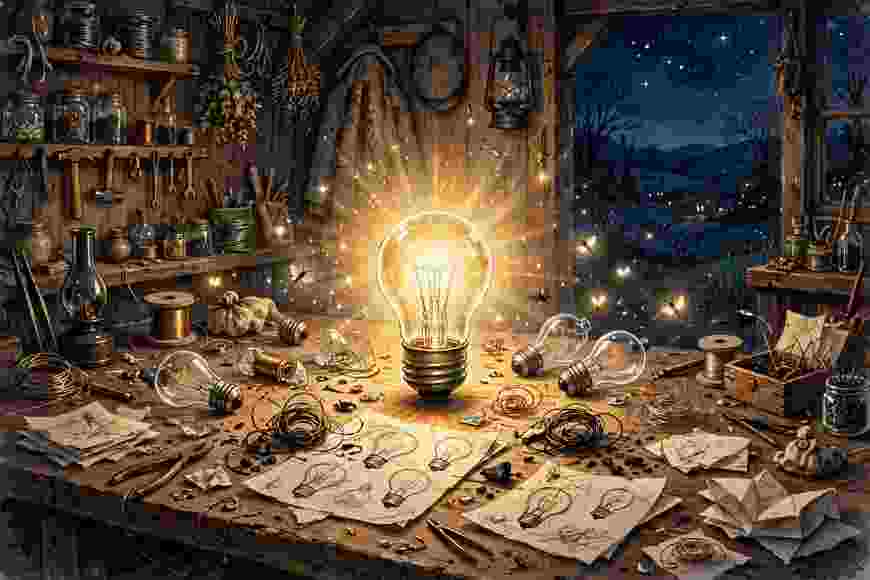
Most people give up after trying something three or four times. Thomas Edison tried to make a single thing work more than a thousand times — and he smiled through almost every one of those tries. His story is one of the most famous examples of patience the world has ever known.
A Boy Who Asked Too Many Questions
Thomas Edison was born in 1847 in Ohio, America. As a boy, he asked so many questions that his schoolteacher gave up on him. His mother, Nancy, decided to teach him at home instead. She filled his room with books and let him experiment with bottles and chemicals in the basement.
By the age of twelve, Thomas was selling newspapers on trains to earn money. He even printed his own little newspaper. He was always working, always wondering, always trying something new.
The Challenge of the Light Bulb
When Edison was a grown man, people lit their homes with candles and gas lamps. Gas lamps were smelly, dangerous, and dirty. Many clever people were trying to build an electric light bulb, but every bulb they made either burned out in seconds or burst into flames.
Edison and his team at Menlo Park, New Jersey, tested material after material for the thin thread — called the filament — inside the bulb. They tried platinum, paper, cotton, wood, and even bamboo. Hundreds of materials failed. Each time, Edison wrote down exactly what happened and tried again.
The Thousandth Try
A helper once asked him if he felt sad about failing so many times. Edison laughed and said he had not failed at all — he had simply found a thousand ways that did not work. That way of thinking kept him going.
Finally, on October 21, 1879, one of their bulbs burned brightly for more than thirteen hours. It worked! Soon whole cities were glowing with electric light. Edison went on to create over a thousand more inventions, including the phonograph and the movie camera.
An Invention Factory
Edison did something no one had ever done before: he built a whole building just for inventing. His laboratory at Menlo Park was like a factory for ideas. He hired smart machinists, glassblowers, and engineers, and they all worked together trying new things day and night. Whenever one of them found something interesting, everyone gathered around to learn from it.
The light bulb was not his only wonder. In 1877, Edison invented the phonograph — a machine that could record and play back sound. People could not believe their ears when a machine "talked" back to them. He also helped create the first motion picture camera, which led to the movies we watch today. Because of his habit of never giving up, he collected 1,093 patents in America alone — more than any other inventor of his time.
Lesson of the Story
Every failed try is a step toward success. When something does not work, you have not failed — you have learned one more way that does not work, and that brings you closer to the way that will.